By the New Empire Remodeling team · Jacksonville, FL
Choosing a floor in Jacksonville is a different problem than choosing one in Denver or Chicago. Our subtropical climate keeps indoor humidity high for most of the year, the majority of local homes sit on a concrete slab that quietly gives off moisture, and hurricane season brings a real risk of water intrusion. Add salt air at the Beaches, and a floor that would last decades up north can cup, swell, gap or grow mold here in a few seasons. The good news: the flooring that survives Florida also happens to be some of the best-looking and easiest to live with — you just have to pick for the climate, not against it.
This guide walks through what “waterproof” actually means (it is not the same as “water-resistant”), which flooring materials genuinely hold up in a Jacksonville home, what each one costs installed in 2026, and the slab-and-humidity details that decide whether your new floor lasts. Whether you’re redoing a whole house in Mandarin, a kitchen in San Marco, or a bathroom in Jacksonville Beach, the same climate rules apply.
Waterproof vs. water-resistant — the distinction that matters here
Flooring marketing uses these two words almost interchangeably, and in Florida the difference can cost you a floor. Water-resistant means the surface can shrug off spills and damp mopping if you wipe them up reasonably soon — but standing water, a slow leak, or high humidity working at the seams will eventually get in. Waterproof means the plank or tile itself will not absorb water or break down even under prolonged exposure; water sits on top until it evaporates or is wiped away, and the material underneath is unaffected.
For a Jacksonville bathroom, laundry room, kitchen or any home in a flood-prone zone, that difference is everything. A water-resistant laminate might look identical to a waterproof vinyl on the showroom floor and cost about the same — but after a supply-line leak or a hurricane’s worth of intrusion, one dries out and the other swells into trash. Knowing which you’re buying is the single most important thing a Florida homeowner can get right.
The best flooring materials for a Jacksonville home
1. Luxury vinyl plank (LVP) — the all-rounder
LVP has become the default recommendation for Florida homes for a reason: quality LVP is fully waterproof, dimensionally stable in humidity, comfortable underfoot, and now convincing enough that it reads as real wood or stone. It handles a concrete slab well, tolerates the temperature and humidity swings we get between a closed-up summer house and a cool AC day, and it’s forgiving of the occasional leak or wet mop. It works in every room, including bathrooms and laundry rooms where you’d never risk real wood. The main trade-off is that it’s a synthetic product — it won’t add the exact resale cachet of genuine hardwood in a high-end home — and cheaper thin-wear-layer versions can dent or show wear, so the tier you buy matters.
2. Porcelain and ceramic tile — the wet-room and coastal champion
Tile is the most water-immune floor you can install, and it’s completely at home in Florida. Porcelain in particular is dense, non-porous and impervious to moisture, which makes it ideal for bathrooms, kitchens, laundry rooms, entryways and anywhere near the coast where salt air is punishing. It also stays cool underfoot in our heat — a genuine comfort advantage from May through September — and today’s large-format and wood-look porcelain planks give you the look of wood with none of the water risk. The downsides are hardness (dropped glassware doesn’t survive, and standing on it all day is tiring), grout that needs occasional sealing to stay clean, and a labor-intensive install that pushes the cost above vinyl.
3. Engineered hardwood — real wood, built for humidity
If you want genuine wood, engineered hardwood is the Florida-smart way to get it. Instead of a solid plank that expands and contracts with every humidity swing, engineered boards are a real-wood veneer over a stable plywood or composite core, so they move far less. That stability is exactly what a humid, slab-on-grade Jacksonville home needs. Engineered wood can often be glued directly to a properly prepped slab, and better lines can be refinished once or twice. It is water-resistant, not waterproof, so it belongs in living rooms, bedrooms and dining rooms — not bathrooms or laundry rooms — and it still needs a moisture barrier over concrete. But for the warmth and value of real wood without the cupping risk of solid, it’s the right call.
4. Solid hardwood — beautiful, but handle with care in Florida
Solid oak or hickory is timeless and adds real resale value, but it’s the material most at odds with our climate. Wood is hygroscopic — it drinks moisture from humid air and from a bare slab — and as it does it swells, then shrinks when the AC dries things out, leaving cups and gaps. Solid hardwood generally can’t be installed directly on a slab (it needs a wood subfloor or a built-up moisture-managed system), and it should never go anywhere it might get wet. It can absolutely work in a Jacksonville home with a raised wood subfloor, disciplined humidity control and correct acclimation — but it demands the most care of anything on this list, and in a flood zone it’s a gamble.
5. Laminate — budget-friendly, but read the label
Laminate gives you a wood look at a low price and it’s tough against scratches and dents, which makes it tempting. The catch in Florida is water: traditional laminate has a fiberboard core that swells and delaminates if water reaches the seams, and once a plank swells there’s no fixing it. Newer “water-resistant” and even “waterproof” laminates exist and are much better, but you have to confirm the rating rather than assume it. For a bedroom or a low-traffic, low-risk room on a budget, a quality water-resistant laminate is reasonable; for bathrooms, kitchens or anywhere a leak is plausible, LVP or tile is the safer money.
6. Carpet — comfort with a humidity asterisk
Carpet still has a place in bedrooms and closets for warmth and quiet, and it’s the cheapest option here. But in Florida’s humidity it’s the highest-maintenance choice: it holds moisture, and damp carpet or padding over a slab is a mold and mildew risk if a room ever floods or a leak goes unnoticed. Keep it out of bathrooms, laundry rooms, entryways and any below-grade or flood-prone space, run your AC to control humidity, and treat it as a bedroom comfort layer rather than a whole-house floor.
2026 flooring costs in Jacksonville
The figures below are typical installed ranges (materials plus labor) for Jacksonville in 2026, drawn from current local pricing data. Your real number depends on the product tier you choose, the condition of your subfloor or slab, and how much old flooring has to come out first. Across all materials, local project pricing platforms put a typical Jacksonville flooring job in the $2,000–$3,000 range for a single area, with whole-home projects running well beyond that.
| Flooring type | Installed cost (2026, Jacksonville) | Florida verdict |
|---|---|---|
| Carpet | $3 – $7 / sq ft | Bedrooms only; humidity/mold caution |
| Laminate | $4 – $8 / sq ft | Water-resistant only — confirm the rating |
| Luxury vinyl plank (LVP) | $5 – $9 / sq ft | Waterproof — best all-round pick |
| Porcelain / ceramic tile | $8 – $15 / sq ft | Fully waterproof — best for wet rooms & coast |
| Engineered hardwood | $10 – $18+ / sq ft | Real wood, humidity-stable; keep out of wet rooms |
| Solid hardwood | $10 – $18+ / sq ft | Highest care; not for slabs or wet areas |
Budget for the extras that don’t show up in a per-square-foot ad. Tearing out and hauling old flooring runs about $1–$3 per sq ft, subfloor or slab repair another $1–$3 per sq ft, and underlayment or a moisture barrier roughly $0.50–$2 per sq ft. As a rough whole-project sense of scale, an 800–1,000 sq ft main living area in LVP typically lands around $4,000–$9,000 installed, while the same area in hardwood can run $8,000–$18,000.
The Jacksonville slab factor — why prep beats product
Most homes here are built on a concrete slab, and concrete is never truly dry — it releases water vapor continuously, especially in a humid climate. Install a floor over a slab that’s giving off too much moisture and you can trap it, which shows up months later as adhesive failure, cupping, or mildew smell. This is why, in Florida, how a floor is installed matters at least as much as which floor you buy:
- Moisture testing the slab before anything goes down, so the crew knows what they’re dealing with rather than guessing.
- A vapor barrier or moisture-mitigation layer over concrete when the material calls for it — non-negotiable under wood and many click floors.
- Acclimating the flooring in the home for a few days so the planks are at the house’s real humidity before they’re locked in place.
- A flat, sound substrate — grinding high spots and filling low ones — because thin waterproof planks telegraph every dip and can flex at unsupported seams.
A waterproof floor installed over an unprepped, moisture-heavy slab can still fail. A correctly prepped slab is what lets even a mid-priced floor last.
Room by room: what we’d put where in a Jacksonville home
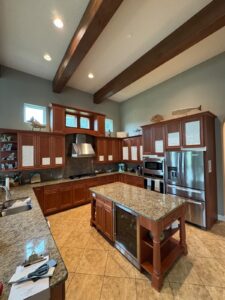
The simplest way to choose is to match the floor to the room’s water risk. Bathrooms, laundry rooms and entryways — the wettest zones — call for porcelain tile or waterproof LVP, full stop. Kitchens do best with LVP or tile, both of which survive spills, dishwasher leaks and mopping; if you’re already updating the kitchen, coordinating the floor with your cabinets and countertops keeps the whole room cohesive. Living and dining rooms and bedrooms are lower-risk and open the door to engineered hardwood or LVP for warmth and looks, with carpet a reasonable bedroom-only comfort choice. Coastal homes at the Beaches — Jacksonville Beach, Neptune, Atlantic and Ponte Vedra — lean hardest toward porcelain tile and quality LVP, because salt air and the higher chance of storm intrusion punish anything that absorbs moisture.
Getting it done right in Jacksonville
The floor you can see is only half the job; the moisture management you can’t see is what determines whether it’s still flat and tight in ten years. Before you hire, ask the installer how they test and prep a slab, whether they use a moisture barrier under your chosen material, and how they handle acclimation — the answers separate a crew that understands Florida from one that installs the same way it would in a dry climate. Confirm the company is licensed and insured in Florida and stands behind the install, not just the product warranty.
At New Empire Remodeling, flooring is part of how we remodel whole kitchens, bathrooms and homes across Jacksonville, so the slab prep, moisture barriers and transitions are handled by one accountable crew rather than left to chance between trades. You can see our full approach on the Jacksonville flooring installation page, and if new floors are part of a bigger project, our kitchen remodeling and bathroom remodeling pages show how it all comes together.
Planning new floors and not sure what survives Florida? Get a free, no-pressure estimate.
Or request your free estimate online — we’ll look at your rooms, your slab and your budget and give you a straight recommendation.
Frequently asked questions
What is the best waterproof flooring for a Jacksonville home?
For most rooms, luxury vinyl plank (LVP) and porcelain tile are the two best waterproof choices in Jacksonville. LVP is fully waterproof, stable in humidity, comfortable underfoot and works everywhere including bathrooms and laundry rooms. Porcelain tile is the most water-immune option of all and is ideal for wet rooms and coastal homes. Both handle our slab-on-grade construction and high humidity far better than solid wood, laminate or carpet.
Is laminate flooring a good idea in Florida?
Only with care. Traditional laminate has a fiberboard core that swells permanently if water reaches the seams, which is a real risk in Florida bathrooms, kitchens and flood-prone areas. Newer water-resistant and waterproof laminates are much better, but you have to confirm the rating rather than assume it. For wet or high-risk rooms, waterproof LVP or porcelain tile is a safer investment; laminate is best kept to low-risk rooms like bedrooms.
Can I install hardwood floors over a concrete slab in Jacksonville?
Engineered hardwood can often be installed over a properly prepped slab with a moisture barrier, because its stable core resists the humidity swings that cause solid wood to cup and gap. Solid hardwood generally should not go directly on a slab — it needs a wood subfloor or a built-up, moisture-managed system, and it should never be installed where it might get wet. In Florida, engineered wood is almost always the smarter way to get a real-wood floor on a slab.
How much does new flooring cost in Jacksonville in 2026?
Installed costs in 2026 typically run about $3–$7 per sq ft for carpet, $4–$8 for laminate, $5–$9 for LVP, $8–$15 for porcelain or ceramic tile, and $10–$18+ for engineered or solid hardwood. A single room often falls in the $2,000–$3,000 range, while an 800–1,000 sq ft area runs roughly $4,000–$9,000 in LVP or more in hardwood. Old-floor removal, subfloor or slab repair, and moisture barriers add to those figures.
Why does humidity matter so much for flooring here?
Jacksonville’s indoor humidity stays high much of the year, and a concrete slab constantly releases water vapor. Materials that absorb moisture — solid wood, standard laminate cores, carpet padding — swell, cup, gap or grow mildew when that moisture isn’t managed. Non-absorbing materials like LVP and porcelain tile are unaffected, which is why they’re the go-to for Florida. Proper slab moisture testing, a vapor barrier and acclimation are what make any floor last here.
What flooring is best for a home near the beach?
Coastal homes at Jacksonville Beach, Neptune, Atlantic and Ponte Vedra face salt air and a higher chance of storm-driven water intrusion, so porcelain tile and quality waterproof LVP are the strongest choices. Both are immune to moisture and won’t corrode or absorb salt-laden humidity the way wood or metal-trimmed products can. Keep carpet and non-waterproof laminate out of coastal wet zones and entryways.
Your next step
The floor that lasts in Jacksonville is the one chosen for our climate — waterproof where water is likely, humidity-stable everywhere, and installed over a slab that’s been properly tested and prepped. Match the material to each room’s water risk, insist on the moisture-management details, and get a real local estimate before you commit to a product. If you’d like an honest read on which floor fits your rooms and your budget, the New Empire team is a phone call away.
New Empire Remodeling · Kitchen & bathroom remodeling and flooring in Jacksonville, FL · (904) 820-5573